
🕊️ Vincent Reyes and the Ethics of Time
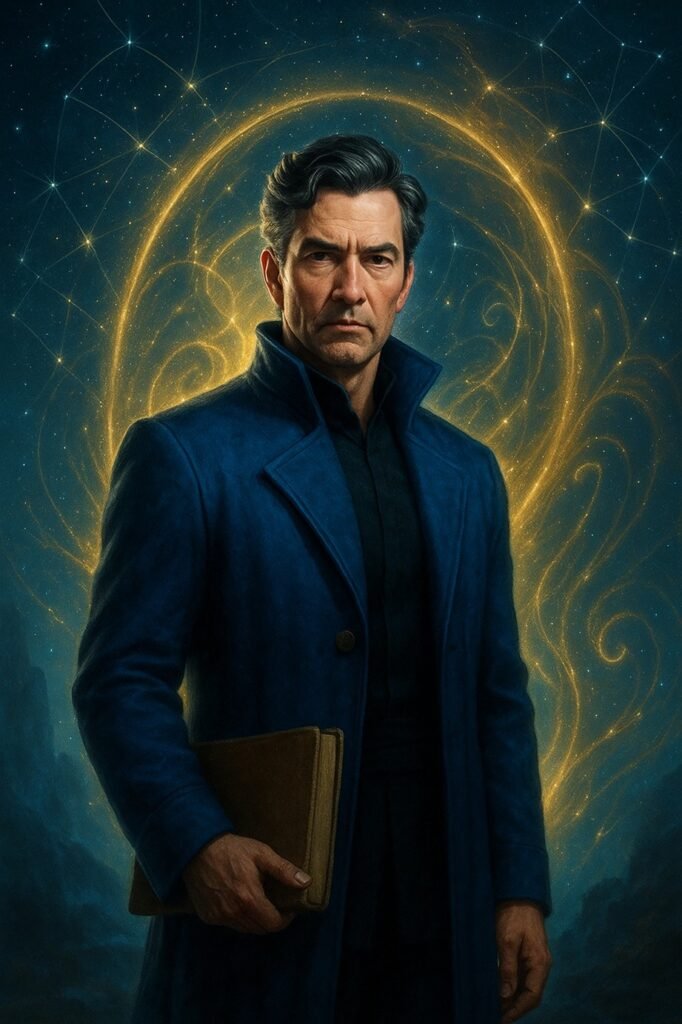
“When timelines collide, a new humanity rises.”
🌀Lessons from a 555-Year-Old Philosopher
In every great tale of transformation, there is a figure who holds the ancient memory—a soul who has lived long enough to see both the light and shadow of civilization unfold. In Timelines Convergence, that figure is Vincent Reyes, the time-traveling philosopher, moral anchor, and quiet guide whose presence is less about command and more about conscience.
At 555 years old, Vincent is not simply wise because of his age.
He is wise because he has suffered.
He is wise because he has witnessed.
He is wise because he has chosen again and again not to close his heart, but to open it wider.
Let us explore Vincent’s role in the saga—his memories, his regrets, his insights—and why, in an age of fractured timelines and accelerating crises, ethics may be the most powerful time-travel technology we have left.
🕰️ Time’s Student, Not Its Master
Vincent Reyes was never meant to be a soldier or a savior.
He began as a seeker—drawn to patterns, to questions, to quantum truths. His early work on timeline harmonics and temporal thresholds eventually led him into deep collaboration with Aurora Earth’s Guardians. But while others honed their combat skills or psychic warfare techniques, Vincent remained focused on one thing:
🌀 The ethical consequences of every choice across timelines.
To him, time was never just a series of events.
It was a living field of relationships.
A ripple in one era could echo in another.
A single unhealed decision could birth generations of distortion.
This awareness made Vincent careful.
Some called him overly cautious.
But when he finally did act—and it led to the tragedy at the Mirror Gate 22 years ago—it broke something inside him.
💔 The Weight of Memory
Vincent is not ageless—he is ancient, in the truest sense of the word.
At 555, he holds more than historical knowledge.
He holds emotional history.
He remembers the softness of Farah’s laughter.
He remembers the exact tone of the silence after Kade’s final breath.
He remembers the version of himself who was so certain—so convinced that he was doing the right thing.
And now, he remembers differently. With nuance. With humility. With grief.
His memory is both a map and a burden.
And yet, it’s precisely this burden that makes him the ideal guide for the young Chosen Ones. He doesn’t lead from a place of ego or superiority—but from compassionate accountability.
🛡️ A Guardian Without a Sword
Vincent rarely raises his voice.
He doesn’t dominate.
He doesn’t manipulate.
But his presence has weight.
In moments when Anya doubts herself, he offers quiet truths.
When Ethan begins to close off, Vincent gently reminds him of the cost.
When Zuri burns too hot with urgency, Vincent steadies the flame without snuffing it out.
He holds space for all of them—while never withholding the truth.
This is what makes him not just a mentor, but a moral Guardian.
Not because he enforces rules—
But because he embodies the why behind them.
🧭 Ethics as Navigation
Time travel in the Aurora Earth Saga is not merely a sci-fi device—it is a spiritual responsibility.
Each jump, each disruption, each ripple has the potential to collapse or heal entire strands of existence. And as more characters begin to access their soul-glyphs and remember their roles across timelines, the question becomes:
🌌 Just because we can change the past… should we?
Vincent doesn’t give easy answers.
Instead, he invites reflection.
He teaches the team how to weigh outcomes not just by effectiveness, but by alignment.
Not just by what prevents disaster—but by what honors free will, truth, and compassion.
In this way, he reframes heroism not as saving the world—but as serving it, with humility.
🔮 The Philosopher of Fractures
Vincent has seen fractured timelines.
He’s felt the distortions ripple through his bones.
He’s witnessed the paradoxes that arise when grief is bypassed and shortcuts are taken.
And he has learned that sometimes the greatest healing comes not from preventing pain—but from walking through it with presence.
This is why, in Chapter 20—The Mirror Gate—Vincent’s reaction is not awe, but ache.
He sees the alternate futures not as hypotheticals, but as realities he helped shape through action and inaction.
And still, he chooses to move forward.
Not to fix everything.
But to make space for right relationship to time, to team, and to soul.
🫀 Vincent’s Heart: The Softest Flame
What many readers love most about Vincent isn’t just his intellect—it’s his heart.
He loves quietly, but fully.
He listens.
He remembers birthdays no one else knows anymore.
He sits beside Anya in her silence.
He notices Ethan’s flash of hesitation.
He knows when to speak… and when to simply be.
There is a tenderness to him that could only have been forged by centuries of witnessing suffering without letting it turn him bitter.
He is, in many ways, the embodiment of hope after collapse.
The philosopher who still believes we can choose better—because he has lived through what happens when we don’t.
📜 Lessons for the Now
Vincent’s arc is more than narrative—it’s an invitation.
In a world that feels fractured…
Where timelines seem to be accelerating…
Where truth feels blurred by emotion and illusion…
Vincent calls us to pause.
To weigh not just the what, but the why.
To choose integrity over impulse.
To lead not with dominance, but with resonance.
He reminds us that wisdom isn’t perfection—it’s presence.
That accountability isn’t shame—it’s remembrance.
That love isn’t weakness—it’s what time was always trying to return us to.
Vincent Reyes doesn’t offer us easy answers.
He offers something rarer:
🕊️ The space to become more human—across time.
With Infinite Starlove,
Iris Starshine
💫
P.S. If Vincent’s wisdom resonates with you—if you’ve ever felt like an old soul navigating new timelines—
join my starlight reader list at irisstarshine.com.
Together, we’ll reflect, remember, and walk the timelines with care. 🌌📜🕰️